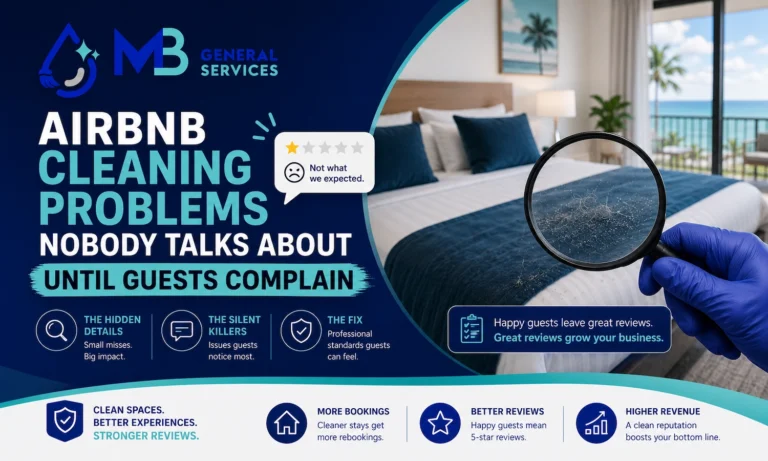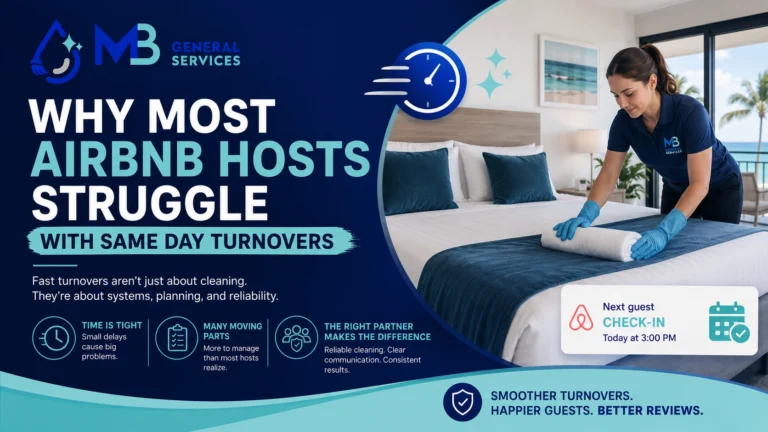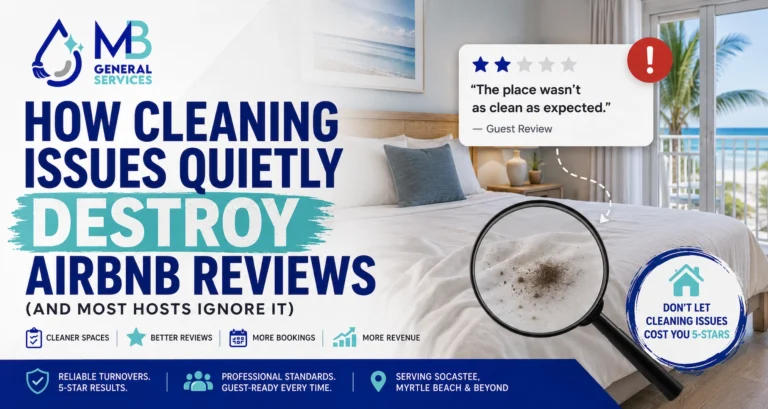
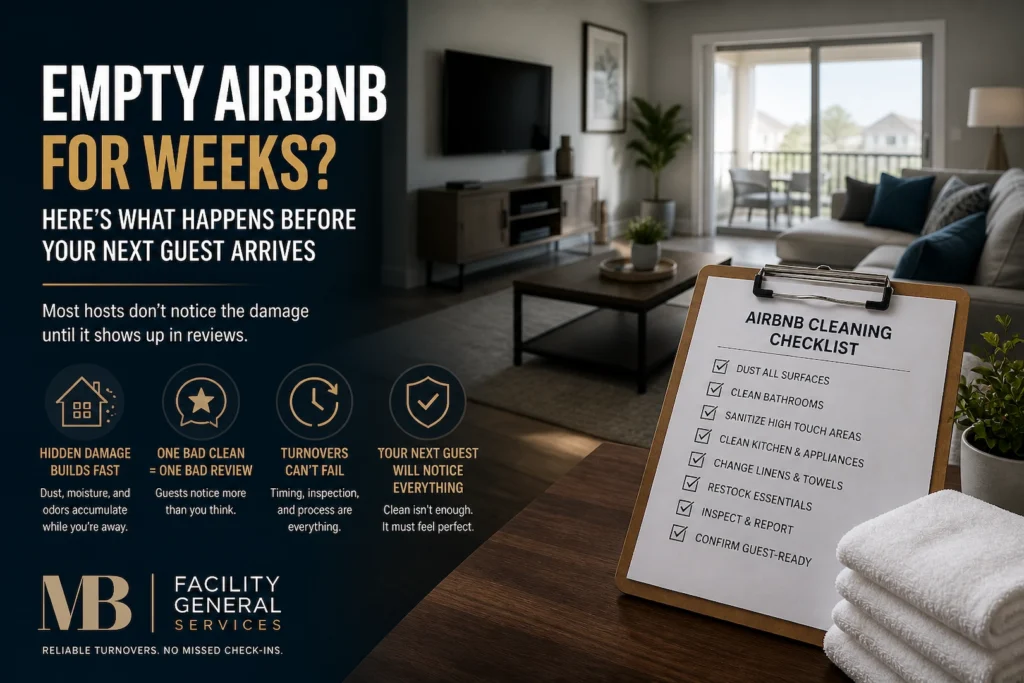
When a house stays empty for weeks, it doesn’t stay “preserved” it quietly deteriorates, accumulates hidden risks, and sets up your next guest experience to fail before they even walk in.
The Direct Answer: What Actually Happens When a House Sits Empty for Weeks
When a property stays vacant for weeks, it does not stay clean it becomes unstable, unpredictable, and risky for your next guest.
Dust accumulates faster than most hosts expect. Moisture builds up silently, especially in humid areas like Socastee and Myrtle Beach. Odors develop from stagnant air. Plumbing systems dry out. Pests find entry points. Surfaces degrade. Air quality declines.
For Airbnb hosts, this creates a chain reaction:
- A guest walks into a property that smells off
- Hidden dust triggers allergies
- Bathrooms show signs of neglect
- Small issues signal poor maintenance
That leads directly to:
- Bad reviews
- Lower ratings
- Loss of booking momentum
- Potential loss of Superhost status
The critical mistake is assuming that “no use = no problem.”
In reality, empty properties require more controlled maintenance, not less.
This is exactly where most hosts in Socastee fail and only realize it after the damage is already reflected in their reviews.
Why This Topic Matters More Than Most Hosts Realize
Most short-term rental hosts, especially those managing remotely or operating multiple listings, assume cleaning is only necessary after guest stays.
That assumption is operationally flawed.
A vacant property behaves differently than an occupied one. Without airflow, movement, or routine cleaning cycles, environmental degradation accelerates.
This directly connects to what actually sells in this market:
- 5-star reviews
- guest satisfaction
- operational consistency
And not just “cleaning” as a task.
This aligns precisely with the real buying motivation of the market: predictability, control, and zero failure between check-out and check-in
What Airbnb Hosts in Socastee Usually Assume (And Why It Backfires)
Common assumptions that lead to operational failure:
- “If no one stayed, it should still be clean”
- “I’ll just do a quick check before the next guest”
- “Cleaning only matters after occupancy”
- “My cleaner will handle it when needed”
These assumptions ignore how short-term rental environments actually behave.
Here’s what really happens instead:
| Assumption | Reality |
| No guests = no mess | Dust, humidity, and odors build up |
| Closed house = protected | Air stagnation worsens conditions |
| Quick clean is enough | Deep reset is often required |
| Cleaner will catch issues | Most cleaners are reactive, not proactive |
The gap between expectation and reality is where airbnb cleaning mistakes begin.
And once those mistakes reach the guest, they become public feedback.
What Changes Inside a House When It Stays Empty
1. Air Quality Degrades Faster Than You Think
Without ventilation, indoor air becomes stale. Odors from previous guests, cleaning products, or humidity get trapped.
This leads to:
- “Smells weird” guest complaints
- First impression failure within seconds
- Negative emotional response before inspection
Suggested cluster topic:
“How Air Quality Impacts Airbnb Reviews More Than Cleanliness”
2. Dust Accumulation Becomes Visible and Problematic
Dust is constant, but without disturbance, it settles everywhere:
- Furniture surfaces
- Baseboards
- Ceiling fans
- HVAC vents
Even after just 2–3 weeks, it becomes noticeable.
Guests interpret this as:
- Lack of cleaning
- Lack of professionalism
- Poor maintenance
Suggested cluster topic:
“Why Dust Is One of the Fastest Ways to Get a Bad Airbnb Review”
3. Humidity Creates Hidden Damage
In regions like Socastee, humidity is not optional it is a constant environmental factor.
When unmanaged, it causes:
- Mold growth in bathrooms and kitchens
- Musty odors in fabrics and upholstery
- Warping of materials
This is one of the most underestimated risks by remote hosts.
Suggested cluster topic:
“How Humidity Destroys Airbnb Properties Without You Noticing”
4. Plumbing Systems Begin to Fail Silently
Unused plumbing leads to:
- Dry traps in drains
- Sewer gas odors entering the property
- Mineral buildup
Guests don’t understand the cause they just report:
- “Bad smell”
- “Bathroom issue”
Which again turns into reviews.
Suggested cluster topic:
“What Happens to Plumbing in Vacant Airbnb Properties”
5. Pest Activity Increases Without Disturbance
Empty properties are ideal environments for:
- Ants
- Roaches
- Spiders
Even minor activity creates a major perception issue.
One sighting = one negative review.
Suggested cluster topic:
“Why Empty Airbnb Properties Attract Pests Faster”
The Real Risk: It’s Not the Dirt It’s the Timing
The biggest mistake is not the condition itself.
It is when the issue is discovered.
Most hosts only realize something is wrong:
- Right before check-in
- Or worse after guest feedback
At that point, there is:
- No time buffer
- No correction window
- No operational control
This is where unreliable cleaning becomes catastrophic.
And this is exactly why Airbnb Cleaning Services in Socastee, SC are not just about cleaning they are about timing precision and execution reliability.
Where Most Hosts Lose Control (Operational Breakdown)
Here is the typical failure sequence:
- Property stays empty for weeks
- No inspection is scheduled
- Cleaner arrives only on turnover day
- Unexpected issues appear
- Cleaning takes longer than planned
- Check-in time is compromised
Result:
- Stress
- Rushed cleaning
- Missed details
- Bad guest experience
This connects directly to the biggest fear in the market:
- Missed check-in
- Bad reviews
- Loss of revenue
Exactly the pain points described in your ICP and persona
Why Reactive Cleaning Fails in Airbnb Operations
Traditional cleaning models are reactive.
Airbnb operations demand:
- predictive cleaning cycles
- scheduled inspections
- standardized checklists
- same-day turnover readiness
Reactive cleaning leads to:
- Inconsistent results
- Unpredictable timelines
- Increased operational risk
Proactive systems lead to:
- Controlled environment
- Faster turnovers
- Higher review consistency
What High-Performance Hosts Do Differently
Top-performing hosts treat cleaning as part of operational infrastructure, not a task.
They implement:
- Regular property checks even without bookings
- Environmental control strategies
- Standardized cleaning workflows
- Backup cleaning plans
They don’t rely on chance.
They rely on systems that guarantee readiness.
How Much Does an Empty Property Actually Cost You Without Proper Cleaning Control
Most hosts calculate revenue based on occupancy.
That’s incomplete.
The real cost comes from operational failure between bookings, especially when a property sits empty and deteriorates silently.
Here’s where the hidden losses happen:
Direct and indirect financial impact
| Scenario | Immediate Cost | Long-Term Impact |
| Guest leaves bad review due to smell or dust | Lost booking | Ranking drop |
| Delayed check-in due to unexpected cleaning | Refund or discount | Trust loss |
| Pest issue reported by guest | Emergency fix cost | Reputation damage |
| Mold or humidity damage | Repair cost | Listing downtime |
Even a single issue can trigger:
- Lower visibility on Airbnb
- Reduced nightly rates
- Fewer bookings over time
This is not theoretical. It is how listing algorithms react to inconsistency and negative signals.
Suggested cluster topic:
“How Cleaning Failures Affect Airbnb Ranking and Revenue”
The Silent Revenue Leak Most Hosts Never Track
When a property stays empty and is not maintained correctly, it creates what can be called a silent revenue leak.
You don’t see it immediately.
You feel it over time.
Where the leak happens
- Slight drop in guest satisfaction
- Minor complaints in reviews
- Reduced conversion rate on listing
- Gradual decline in occupancy
No single event seems catastrophic.
But together, they erode performance.
This aligns with one critical truth in this market:
- Hosts don’t lose money because of one big mistake
- They lose money through small, repeated operational failures
And most of those failures start with cleaning inconsistency.
Real Scenario: What Happens Before a Bad Review Is Written
Let’s walk through a realistic situation.
Example: Empty Property for 3 Weeks in Socastee
- Property stays closed
- Humidity builds up
- Light dust accumulates
- Bathroom traps dry out
- Slight odor develops
Cleaner arrives on turnover day:
- Notices smell
- Needs extra time
- Rushed due to check-in deadline
Guest arrives:
- Notices odor immediately
- Sees minor dust
- Questions cleanliness
Result:
“The place looked clean, but smelled weird. Not what I expected.”
That is a 4-star review instead of 5.
And that difference changes everything.
Why One 4-Star Review Is More Dangerous Than You Think
Most hosts underestimate this.
On platforms like Airbnb:
- 4.8+ rating = high visibility
- 4.6–4.7 = reduced competitiveness
- Below that = significant drop
So one review can:
- Lower average rating
- Affect booking decisions
- Reduce perceived quality
This connects directly to what your ICP actually values:
- 5-star consistency
- predictable guest experience
- zero surprises
Independent Cleaner vs Professional Cleaning Services System
This is where most hosts make the wrong decision.
They compare price.
They should be comparing risk exposure.
Comparison Table
| Factor | Independent Cleaner | Structured Cleaning Service |
| Availability | Unpredictable | Scheduled and controlled |
| Accountability | Low | High |
| Process standardization | Rare | Defined SOPs |
| Inspection system | Usually none | Built-in |
| Same-day turnover capability | Limited | Designed for it |
| Backup plan | None | Operational redundancy |
What this means in practice
An independent cleaner may work well when everything is normal.
But Airbnb operations are not about normal days.
They are about:
- Tight timelines
- Unexpected issues
- High guest expectations
And that’s where systems outperform individuals.
Advantages vs Disadvantages: The Real Trade-Off
Advantages of Professional Cleaning Services Systems
- Consistency across every turnover
- Defined cleaning checklist and inspection
- Faster response to unexpected issues
- Reduced operational stress
- Better alignment with Airbnb standards
Disadvantages
- Higher upfront cost
- Requires trust in provider
- May feel less flexible initially
Advantages of Independent Cleaners
- Lower cost
- Direct communication
- Flexible scheduling in some cases
Disadvantages
- High variability in quality
- No operational backup
- Higher risk of no-show
- Limited scalability
After listing these points, the pattern becomes clear:
Lower cost often equals higher risk.
And in Airbnb, risk translates directly into lost revenue.
Why “Cheap Cleaning” Is the Most Expensive Mistake
This is one of the most common airbnb cleaning mistakes.
Choosing based on price alone leads to:
- Missed cleans
- Rushed jobs
- Inconsistent results
And those issues show up exactly where it hurts most:
- Guest experience
- Reviews
- Booking performance
What looks like savings becomes:
- Discounts to unhappy guests
- Emergency fixes
- Long-term ranking loss
What Happens When Cleaning Fails Right Before Check-In
Timing is everything in short-term rental operations.
When something goes wrong close to check-in:
Immediate consequences
- Panic coordination
- Last-minute fixes
- Reduced cleaning quality
Guest-facing impact
- Late entry
- Visible flaws
- Loss of trust
Business impact
- Refunds
- Negative reviews
- Potential cancellations
This is why cleaning must be treated as:
- A time-critical operation, not a simple task
- A core system, not an optional service
Why Remote Hosts Are the Most Exposed to This Risk
If you are not physically present, your risk multiplies.
Remote hosts depend entirely on:
- Cleaner reliability
- Communication clarity
- Process transparency
Without control, you face:
- Blind spots in property condition
- Delayed problem detection
- Higher stress levels
This is exactly why remote investors are one of the most valuable segments and also the most vulnerable
The Role of a Reliable Cleaning Infrastructure
This is where the shift happens.
You stop thinking about cleaning as a service.
You start thinking about it as operational infrastructure.
A reliable professional cleaning service should provide:
- Scheduled maintenance even without bookings
- Pre-arrival inspections
- Standardized checklists
- Communication updates
- Photo verification
That transforms cleaning from:
- Reactive → Predictable
- Stressful → Controlled
- Risky → Stable
Where Most Content Online Gets It Wrong
Most content talks about:
- How to clean
- What products to use
- Tips for better results
That is surface-level.
The real issue is:
- Operational reliability
- Timing precision
- Consistency across turnovers
And that is what actually drives:
- Reviews
- Rankings
- Revenue
How to Prevent Cleaning Failures Before They Happen in Airbnb Operations
At this point, one thing is clear:
Cleaning failures don’t happen during cleaning they happen before it even starts.
They happen because there is no system controlling what should happen when a property sits empty, especially for weeks.
What a 5-Star-Ready Property Actually Means for Your Next Guest
Most hosts believe “clean” is enough.
It isn’t.
A property that generates 5-star reviews must meet three non-negotiable conditions:
- Immediate visual approval
- Neutral or pleasant scent upon entry
- Perception of perfect preparation
Key elements that define a guest-ready property
- No visible dust on surfaces or hidden areas
- Fresh-smelling environment with proper airflow
- Bathrooms that look untouched and fully reset
- Linen positioned with precision and consistency
- Temperature and ventilation aligned with comfort expectations
This is not about cleaning tasks.
This is about controlling the guest’s first impression within seconds.
Suggested cluster topic:
“What Guests Notice in the First 30 Seconds Inside an Airbnb”
Why Most Airbnb Cleaning Processes Break Down
The issue is rarely effort.
It is structure.
Where operational failure usually begins
- No standardized cleaning checklist
- No post-cleaning inspection
- No maintenance routine during vacancy
- Cleaner decides what matters instead of following a system
What this creates
- Inconsistent cleaning quality
- Dependence on individual judgment
- Unpredictable guest experience
This directly leads to:
- inconsistent cleaning results
- missed expectations
- negative guest feedback
The Airbnb Turnover Workflow That Actually Works
This is where most hosts lack clarity.
A reliable operation follows a defined sequence.
Step-by-step operational flow
- Check-out confirmation
- Initial property inspection
- Identification of hidden issues
- Cleaning execution based on checklist
- Restocking and property setup
- Final inspection and validation
- Confirmation of guest-ready condition
Comparison: informal vs structured workflow
| Step | Informal Process | Structured Process |
| Initial inspection | Skipped | Mandatory |
| Checklist | None or mental | Documented and enforced |
| Time control | Unpredictable | Measured and optimized |
| Final inspection | Rare | Required |
| Readiness validation | Subjective | Standardized |
The difference is not small.
It defines whether your operation is reliable or exposed.
What Happens When a Property Has Been Empty for Weeks
A vacant property should never be treated as a normal turnover.
It requires a full operational reset.
Essential checklist for vacant properties
- Open windows and restore airflow
- Check for trapped odors in closed areas
- Run water in all sinks and showers
- Inspect for humidity and mold presence
- Remove accumulated dust from all surfaces
- Check for pest activity
- Test appliances and systems
Why this step is critical
Because the environment has changed.
Even without guests, the property has degraded in subtle ways.
Ignoring this results in:
- Poor first impression
- Guest discomfort
- Negative perception of cleanliness
Suggested cluster topic:
“How to Reset an Airbnb Property After Long Vacancy”
Deep Cleaning vs Turnover Cleaning: Why This Distinction Matters
Many hosts confuse these two processes.
They serve completely different purposes.
Comparison table
| Cleaning Type | Objective | Frequency | Impact |
| Turnover Cleaning | Prepare for next guest | After each stay | Maintain standard |
| Deep Cleaning | Restore full condition | Periodic or after vacancy | Correct accumulated issues |
Practical explanation
Turnover cleaning maintains.
Deep cleaning restores.
When a property stays empty for weeks, both are required.
Not just a quick reset.
Why Inspection Is the Missing Layer in Most Cleaning Setups
Cleaning without inspection is assumption.
What inspection actually does
- Detects issues before the guest arrives
- Confirms consistency across turnovers
- Creates a repeatable quality standard
Core components of an effective inspection
- Checklist validation
- Full visual walkthrough
- Functional testing of critical elements
- Air quality and odor check
Without inspection, you are relying on chance.
And chance does not scale.
How Same-Day Turnover Works Without Compromising Quality
This is one of the most sensitive operations in short-term rentals.
Typical timing constraint
- Check-out at 11 AM
- Check-in at 3 PM
What must happen in that window
- Full cleaning execution
- Inspection
- Issue resolution
Requirements for success
- Trained team with defined roles
- Structured workflow
- Time control and scheduling precision
- Fast communication
Without these elements:
- Delays happen
- Quality drops
- Risk increases
Suggested cluster topic:
“How to Handle Same-Day Airbnb Turnovers Without Failure”
Operational Metrics You Should Be Tracking (But Probably Aren’t)
Professional Airbnb operations rely on data.
Key performance indicators
- Average cleaning time per property
- Rework rate after cleaning
- Post-cleaning issue frequency
- Time from check-out to readiness
Why these metrics matter
They reveal:
- Bottlenecks in your process
- Weak points in execution
- Opportunities for optimization
Without tracking, you operate based on perception.
And perception hides problems.
Communication and Verification: The Layer That Creates Real Control
Even with process, lack of communication breaks the system.
What should be standard
- Cleaning start confirmation
- Status updates during execution
- Completion notification
- Visual proof of results
Photo verification
This is critical for:
- Remote control
- Quality validation
- Risk reduction
Without verification, you are trusting blindly.
Why Systems Always Outperform Individuals in Airbnb Cleaning
This is not about people.
It is about structure.
Core difference
- Individuals rely on memory and effort
- Systems rely on process and repetition
Impact on operations
- Fewer errors
- Higher consistency
- Better guest experience
And ultimately:
- More positive reviews
- Better rankings
- Higher revenue
Where Most Airbnb Hosts Still Fail
Even after understanding all of this, most hosts still:
- Skip vacancy maintenance
- Avoid implementing checklists
- Ignore inspection
- Do not track performance
Why this happens
Because they still treat cleaning as a task.
Instead of recognizing it as a core operational system.
How to Choose the Right Cleaning Strategy Before It Costs You Reviews
At this stage, one thing is no longer debatable:
Cleaning is not a task it is a control system that directly impacts your revenue, ranking, and guest experience.
The decision now is operational, not optional.
You either rely on inconsistent execution…
or you build a structure that guarantees results.
What You Should Look for in Airbnb Cleaning Services in Socastee, SC
Not every cleaning provider is built for short-term rental operations.
That distinction matters more than most hosts realize.
Non-negotiable criteria
- Same-day turnover capability
- Standardized cleaning checklist
- Post-cleaning inspection process
- Real-time communication and updates
- Consistent team assignment
- Ability to handle vacant property resets
These elements are directly tied to what actually drives performance:
- 5-star reviews
- guest satisfaction
- operational efficiency
What this means in practice
You are not hiring someone to clean.
You are assigning responsibility for:
- Your next guest experience
- Your review consistency
- Your operational reliability
How to Evaluate a Cleaning Provider Before Hiring
Most hosts evaluate based on price.
That is a flawed approach.
The correct evaluation is based on risk and control.
Decision checklist
- Do they operate with a documented process or informal routines?
- Is inspection part of every cleaning cycle?
- Can they handle properties that have been vacant for weeks?
- Do they have a contingency plan for delays or issues?
- Do they understand Airbnb standards or only residential cleaning?
Quick evaluation table
| Criteria | Weak Provider | Strong Provider |
| Process | Informal | Standardized |
| Communication | Delayed | Immediate |
| Reliability | Inconsistent | Predictable |
| Control | Low | High |
| Scalability | Limited | Structured |
After reviewing this, the difference becomes clear:
One option reduces risk.
The other amplifies it.
What Questions You Must Ask Before Hiring
Most hosts ask surface-level questions.
That is not enough.
Strategic questions that reveal operational strength
- “How do you handle same-day turnovers under time pressure?”
- “What happens if something goes wrong before check-in?”
- “Do you perform inspections or only cleaning?”
- “How do you ensure consistency across multiple cleans?”
- “What is your process for properties that stayed empty?”
Why these questions matter
They expose:
- Operational maturity
- Execution reliability
- Risk management capability
Without asking these, you are guessing.
The Role of a Reliable Cleaning Service in Scaling Your Airbnb
Once this layer is solved, everything changes.
A reliable cleaning service allows you to:
- Operate multiple properties without chaos
- Reduce operational stress
- Maintain consistent standards
- Scale without increasing complexity
Without this, growth becomes unstable.
With it, growth becomes controlled.
This directly aligns with what serious hosts aim for:
- Scalability with predictability
Advantages of Structuring Cleaning as an Operational System
Primary advantages
- Reduced operational failures
- Consistent guest experience
- Standardized execution
- Faster and more reliable turnovers
- Lower stress and higher control
Comparison: without system vs with system
| Aspect | Without System | With System |
| Consistency | Low | High |
| Risk | High | Controlled |
| Growth | Limited | Scalable |
| Quality | Variable | Standardized |
Practical interpretation
Without a system, you react to problems.
With a system, you prevent them.
And prevention is what protects your listing.
How Cleaning Impacts Airbnb Algorithm and Listing Performance
This is often overlooked.
Cleaning is not isolated.
It feeds into a larger performance chain.
Impact chain
Cleaning quality → Guest experience → Review score → Listing visibility → Revenue
What this means
- Poor cleaning reduces guest satisfaction
- Lower satisfaction reduces review scores
- Lower scores reduce ranking
- Lower ranking reduces bookings
This is a direct operational link.
Not a theoretical one.
What High-Performance Hosts Already Understand
Experienced hosts operate differently.
They do not:
- Rely on individual performance
- Accept inconsistency
- Operate without inspection
They build:
- Systems
- Processes
- Control layers
Because they understand one core principle:
Consistency drives reviews.
Reviews drive revenue.
Strategic Closing: The Decision That Defines Your Operation
At this point, the path is clear.
You can continue:
- Hoping your next cleaning goes well
- Reacting to problems after they happen
- Accepting variability as normal
Or you can:
- Implement structured processes
- Ensure inspection and verification
- Build a system that guarantees readiness
Because at the end of the day:
Your guest does not evaluate your effort.
Your guest evaluates the result.
FAQ What Airbnb Hosts in Socastee Still Need to Know
- What happens if I don’t clean my Airbnb between guests?
You significantly increase the risk of negative reviews. Even minor issues like dust or odor are immediately noticed and directly impact guest satisfaction and ratings.
- How often should an Airbnb be cleaned if it stays empty?
Regular inspection and light maintenance should occur even without occupancy. After several weeks, a deeper cleaning process is required before the next check-in.
- Is turnover cleaning enough after a long vacancy?
No. A vacant property requires a full operational reset, including inspection, airflow restoration, system checks, and deeper cleaning.
- What are the most common airbnb cleaning mistakes?
The most critical mistakes include:
- Ignoring odor buildup
- Skipping inspection
- Relying on unstructured cleaners
- Failing to account for vacancy impact
These mistakes typically appear in guest reviews.
- Can poor cleaning affect my Airbnb ranking?
Yes. Lower review scores reduce listing visibility, which directly impacts booking performance and revenue.
- How do I know if my cleaning provider is reliable?
A reliable provider demonstrates:
- Structured process
- Consistent execution
- Clear communication
- Ability to handle unexpected issues
Without these, reliability is compromised.
- What is the difference between residential cleaning and Airbnb cleaning?
Residential cleaning focuses on maintenance.
Airbnb cleaning focuses on:
- Guest experience
- Timing precision
- Consistency across turnovers
- Do I need Airbnb Cleaning Services in Socastee, SC if I have only one property?
Yes. Even a single property is highly sensitive to reviews. One failure can impact your entire listing performance.
Final Insight
If there is one principle to retain:
You are not managing cleaning.
You are managing perception, timing, and consistency.
And those three factors define your success in Airbnb.