Same day turnovers fail because most hosts treat them like a cleaning task, when they are actually a tight operational handoff between guest departure, property reset, inspection, restocking, laundry, communication, and the next check in.
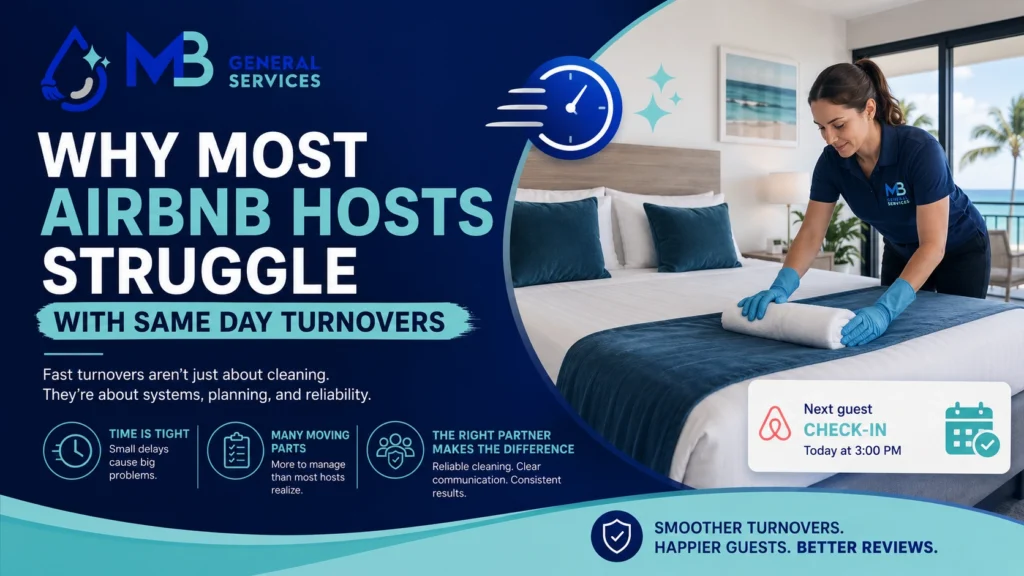
Most Airbnb hosts struggle with same day turnovers because the margin for error is brutally small. A guest may leave late, laundry may take longer than expected, supplies may run out, damage may go unnoticed, and the next guest may arrive before the property is fully reset. The problem is not just dirt. The real problem is broken timing, unclear responsibility, inconsistent standards, and weak communication between the host, cleaner, property manager, and guest.
For hosts in Socastee and the Myrtle Beach area, the pressure is even higher because short term rental demand often compresses cleaning windows into a few hours. That is why Airbnb Cleaning Services in Socastee, SC matter. A reliable turnover process protects the listing, the guest experience, the host’s revenue, and the review score. The hosts who win are not the ones who “clean faster.” They are the ones who build a repeatable system that makes every property guest ready before the next check in.
Why do same day turnovers break down so often?
Same day turnovers break down because hosts underestimate the number of moving parts involved. A turnover is not one task. It is a chain of dependent actions where one delay can contaminate the entire schedule.
A simple turnover may include checkout confirmation, trash removal, linen change, laundry coordination, bathroom reset, kitchen reset, floor cleaning, bed staging, amenity refill, damage inspection, photo verification, and final readiness check. If one step is skipped, the next guest notices.
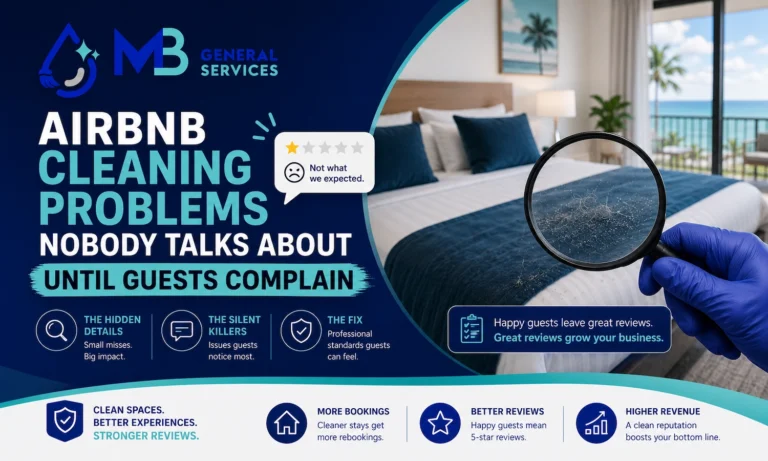
Most hosts only see the visible part of the job: the property looks clean or it does not. But guests evaluate the invisible part too. They notice missing towels, sticky counters, hair in the shower, low toilet paper, stained sheets, bad smells, full trash bins, unmade beds, and signs that the property was rushed.
That is where turnover challenges become expensive. A late clean does not just create stress. It creates review risk, refund requests, support messages, and possible damage to listing performance.
What makes same day turnover different from regular cleaning?
Same day turnover is different because the property must be cleaned, reset, inspected, and guest ready within a fixed operational window. Regular house cleaning has flexibility. Turnover cleaning does not.
| Factor | Regular House Cleaning | Same Day Airbnb Turnover |
| Time pressure | Flexible | Strict checkout to check in window |
| Quality standard | Home comfort | Guest review standard |
| Scope | Cleaning focused | Cleaning, staging, restocking, inspection |
| Risk | Client dissatisfaction | Bad review, refund, lost revenue |
| Communication | Occasional updates | Fast operational updates |
| Final result | Clean home | Guest ready rental |
A normal cleaner can do a good job in a normal home and still fail inside an Airbnb operation. That is the point most hosts miss. The standard is not “clean enough.” The standard is whether the next guest walks in and feels the property was prepared specifically for them.
Why do hosts underestimate the turnover window?
Hosts underestimate the turnover window because they calculate the job based on cleaning time, not operational time. That is weak thinking. The cleaner is not just wiping surfaces. The cleaner is absorbing all the friction between one guest leaving and another guest arriving.
A realistic turnover window must account for:
- Guest leaving late
- Parking access or entry delays
- Laundry volume
- Stained linens
- Trash overflow
- Missing supplies
- Extra mess from families or groups
- Pet hair when allowed
- Sand, moisture, and beach traffic
- Damage notes and reporting
- Final photos before departure
This is why cheap turnover planning collapses. It assumes ideal conditions. Real short term rental operations rarely run on ideal conditions, especially during high occupancy periods.
The smarter approach is to build the schedule around risk, not hope. If a property usually takes two hours to clean, the operational plan should not assume two perfect hours. It should include buffer time, escalation rules, and a clear process to fix turnover issues before they reach the next guest.
How does poor turnover affect Airbnb reviews?
Poor turnover affects Airbnb reviews because cleanliness is one of the fastest ways for a guest to lose confidence in the entire stay. One visible miss can make the guest question everything else.
A guest who sees hair in the bathroom does not think, “small mistake.” They think, “Was this place actually cleaned?” That shift is dangerous because the guest begins inspecting the property with suspicion. Every small flaw becomes bigger.
Common review triggers include:
- Dirty bathrooms
- Used linens
- Crumbs or grease in the kitchen
- Dust on visible surfaces
- Trash left behind
- Poor odor control
- Missing paper products
- Unclear staging
- Signs of rushed preparation
The host may think the cleaner “mostly did fine.” The guest does not score effort. The guest scores confidence, comfort, and readiness. That is why Professional Cleaning Services in Myrtle Beach, SC can become a revenue protection decision, not just a cleaning expense.
Why is consistency more important than deep cleaning?
Consistency is more important than deep cleaning because Airbnb guests judge the stay based on the condition they experience at arrival. A deep clean once a month does not protect a host if the property feels rushed today.
Deep cleaning matters, but it does not replace turnover discipline. The best system separates both:
| Cleaning Type | Main Purpose | Best Use |
| Turnover cleaning | Prepare for the next guest | Every checkout before check in |
| Deep cleaning | Restore neglected areas | Scheduled monthly or seasonal |
| Maintenance cleaning | Prevent long term deterioration | Between peak periods |
| Inspection cleaning | Catch guest facing issues | Before high value bookings |
The mistake is using deep cleaning as a bandage for a broken turnover process. That does not work. If beds are staged poorly, towels are missing, trash is still outside, and the bathroom has hair in the drain, the guest will not care that the baseboards were deep cleaned two weeks ago.
What are the biggest hidden causes of same day turnover failure?
The biggest hidden causes are weak systems, vague expectations, and no final verification. Most failures are predictable. Hosts just pretend they are random because admitting the system is broken is uncomfortable.
| Hidden Cause | What It Looks Like | Operational Risk |
| No checklist | Cleaner works from memory | Missed details |
| No photo proof | Host cannot verify remotely | Blind trust |
| No supply tracking | Guests arrive with missing items | Complaint risk |
| No laundry plan | Linens delay the entire reset | Late check in |
| No damage reporting | Problems discovered by guests | Refund request |
| No backup cleaner | One no show breaks the schedule | Turnover failure |
| No timing standard | Everyone guesses | Stress and delays |
This is the brutal truth: if a host has no checklist, no backup plan, no inspection workflow, and no communication standard, the same day turnover problem is not the cleaner’s fault alone. The operation was fragile before the cleaner arrived.
That is why Airbnb Cleaning Services in Socastee, SC should be evaluated around process, not just price. A host does not need someone who says “yes” to every clean. A host needs someone who can execute under pressure.
What should a reliable same day turnover process include?
A reliable same day turnover process should include clear timing, defined responsibilities, cleaning standards, inspection points, supply checks, and proof of completion. Without these, the host is gambling with the next review.
A strong process includes:
- Checkout confirmation
The team knows when the previous guest leaves and when access is available. - Arrival confirmation
The cleaner confirms they are on site, not “on the way” indefinitely. - Room by room reset
Bedrooms, bathrooms, kitchen, living areas, outdoor spaces, and entry points are handled in a consistent order. - Laundry and linen control
Used linens are removed, clean linens are installed, and shortages are flagged immediately. - Restocking check
Toilet paper, paper towels, soap, trash bags, coffee supplies, and guest basics are verified. - Damage and issue report
Broken items, stains, missing objects, and unusual messes are documented. - Photo verification
The host receives visual confirmation that the property is ready. - Final guest ready inspection
The property is checked from the perspective of the next guest walking in.
This turns cleaning into an operating system. That is the difference between “the place was cleaned” and “the property was ready.”
How Do Successful Airbnb Hosts Handle Same Day Turnovers?
Successful hosts do not rely on luck, availability, or last minute coordination. They build systems that remove uncertainty from the turnover process.
The highest performing hosts treat their vacation rental like a hospitality business, not a side project. Every turnover follows the same workflow, every cleaner follows the same standards, and every property is inspected before the next guest arrives.
The difference becomes obvious during peak travel seasons in the Myrtle Beach area. While unprepared hosts are scrambling to solve cleaning emergencies, organized hosts are following documented processes.
The most effective operators focus on:
- Standardized cleaning checklists
- Predictable scheduling
- Reliable communication
- Backup coverage plans
- Inventory management
- Quality control inspections
- Photo documentation
These systems reduce human error and create operational stability. More importantly, they reduce the stress that comes from constantly worrying about the next check in.
What Happens When a Same Day Turnover Goes Wrong?
Most hosts think a failed turnover means a dirty property. In reality, the consequences are much broader.
A failed turnover can trigger:
- Guest complaints
- Negative reviews
- Refund requests
- Delayed check ins
- Customer support disputes
- Lower occupancy rates
- Reduced listing visibility
- Revenue loss
The chain reaction is what makes turnover failures dangerous.
Consider this example:
A guest checks out at 11:00 AM.
The cleaner arrives late due to scheduling conflicts.
Laundry takes longer than expected.
The next guest arrives at 4:00 PM and discovers unfinished cleaning.
The guest contacts Airbnb support.
A partial refund is issued.
A four star review replaces a potential five star review.
Future guests see the lower rating.
Booking conversion declines.
What started as a timing issue becomes a revenue issue.
This is why experienced operators view turnover cleaning as risk management.
How Much Can Turnover Problems Cost an Airbnb Host?
Many hosts underestimate the financial impact of operational failures.
The visible cost is obvious:
| Direct Cost | Example |
| Refunds | Partial guest reimbursement |
| Rebooking support | Alternative accommodation assistance |
| Emergency cleaners | Last minute premium rates |
| Damaged reputation | Lower booking conversion |
The hidden costs are often larger.
| Hidden Cost | Long Term Impact |
| Lower review scores | Reduced trust |
| Ranking decline | Less visibility |
| Fewer repeat guests | Reduced lifetime value |
| Lower occupancy | Revenue reduction |
| Host stress | Poor operational decisions |
A single negative review can influence dozens of future booking decisions.
For hosts managing multiple properties, the impact compounds quickly.
This is one reason many investors eventually seek Professional Cleaning Services in Myrtle Beach, SC rather than relying on inconsistent freelance solutions.
The goal is not simply keeping properties clean.
The goal is protecting revenue producing assets.
Why Are Remote Airbnb Investors More Vulnerable?
Remote investors face a unique challenge.
They cannot physically inspect the property between guests.
They depend entirely on systems, communication, and trusted partners.
According to the ICP behind most successful vacation rental operations in Socastee, many property owners live outside the area and rely completely on third party support.
This creates several risks:
- Limited visibility
- Delayed issue detection
- Communication gaps
- Vendor dependency
- Reduced quality control
For a local host, a cleaning issue might be a short drive away.
For an out of state investor, the same issue could be hundreds of miles away.
That is why remote operators prioritize:
- Inspection reports
- Photo verification
- Consistent cleaning teams
- Reliable scheduling
- Clear communication protocols
Trust becomes a business asset.
Without trust, scaling becomes almost impossible.
Why Do Freelance Cleaners Struggle With Complex Turnovers?
This is not an attack on independent cleaners.
Many independent cleaners do excellent work.
The problem is operational capacity.
A same day turnover is not always a cleaning challenge. Often it is a logistics challenge.
Independent cleaners frequently face:
- Transportation delays
- Scheduling conflicts
- Equipment limitations
- Laundry bottlenecks
- Capacity constraints
- No backup coverage
When a cleaner becomes unavailable, the entire operation can stall.
By contrast, structured cleaning operations often have:
- Team redundancy
- Scheduling systems
- Defined procedures
- Escalation workflows
- Backup personnel
This distinction becomes critical during busy tourism periods.
Hosts who experience repeated turnover challenges usually discover that reliability matters more than hourly pricing.
The cheapest option can become the most expensive option when a turnover fails.
What Does a Five Star Ready Property Actually Look Like?
Many hosts misunderstand guest expectations.
Guests do not evaluate cleaning the way cleaners evaluate cleaning.
Guests evaluate experiences.
A five star ready property typically includes:
Bedroom Standards
- Crisp linens
- Properly staged beds
- No visible dust
- Fresh smell
- Organized appearance
Bathroom Standards
- Spot free mirrors
- Sanitized fixtures
- Fresh towels
- Fully stocked essentials
- No hair or residue
Kitchen Standards
- Clean appliances
- Sanitized counters
- Empty trash
- Restocked necessities
- Organized presentation
Living Area Standards
- Vacuumed floors
- Clean furniture
- Organized décor
- Dust free surfaces
- Functional amenities
Arrival Standards
- Easy access
- Pleasant first impression
- Consistent temperature
- Proper lighting
- Guest readiness
Notice something important.
Very few of these expectations involve deep cleaning.
Most involve consistency.
That is why operational discipline often outperforms occasional intensive cleaning efforts.
How Do Airbnb Algorithms Indirectly Reward Better Turnovers?
Most hosts focus exclusively on guest reviews.
The smarter hosts focus on the metrics that influence reviews.
A strong turnover process can indirectly support:
- Higher guest satisfaction
- Better review scores
- Increased booking conversion
- Improved occupancy performance
- Stronger host reputation
Consider the relationship below:
| Operational Factor | Guest Perception | Business Outcome |
| Clean property | Professional host | Better reviews |
| On time readiness | Reliable experience | Higher satisfaction |
| Consistent standards | Trust | Repeat bookings |
| Fully stocked amenities | Convenience | Positive feedback |
| Fast issue resolution | Responsiveness | Reputation growth |
The algorithm itself does not inspect properties.
Guests do.
The algorithm reacts to guest behavior.
Therefore, every operational improvement has the potential to influence listing performance indirectly.
This is one of the least discussed aspects of short term rental growth.
Many hosts spend thousands on furnishings, photography, and amenities while ignoring the operational system that protects those investments.
Why Is Communication Just As Important As Cleaning?
Cleaning solves visible problems.
Communication prevents invisible problems from becoming disasters.
The strongest turnover systems include communication checkpoints at every stage.
Examples include:
- Checkout confirmation received
- Cleaner dispatched
- Property entered
- Cleaning completed
- Inspection completed
- Photos submitted
- Property guest ready
This approach reduces uncertainty for hosts.
A host should never wonder:
- Did someone arrive?
- Was the property cleaned?
- Were supplies restocked?
- Was damage discovered?
- Is the unit ready?
If those questions remain unanswered, operational anxiety remains high.
The best systems eliminate uncertainty through transparency.
This is especially important for hosts trying to fix turnover issues that have already caused poor reviews, scheduling conflicts, or guest complaints.
When communication improves, operational control improves.
When operational control improves, guest experiences become more consistent.
And consistency is ultimately what separates struggling Airbnb listings from high performing ones.
What Are the Most Common Same Day Turnover Mistakes Airbnb Hosts Make?
Most turnover failures are not caused by a lack of effort. They are caused by flawed systems.
Hosts often focus on working harder when they should be focusing on removing operational friction.
The most common mistakes include:
| Mistake | Immediate Impact | Long Term Consequence |
| No documented checklist | Inconsistent cleaning | Lower review scores |
| No backup cleaner | Missed turnover | Guest dissatisfaction |
| Poor laundry planning | Delayed readiness | Check in issues |
| No inventory management | Missing essentials | Negative reviews |
| No final inspection | Hidden problems | Refund requests |
| Reactive scheduling | Constant emergencies | Host burnout |
| No communication workflow | Uncertainty | Operational chaos |
Most of these issues are preventable.
The challenge is that many hosts only recognize the problem after receiving a poor review.
By that point, the damage has already reached the guest.
Why Does Laundry Become a Major Turnover Bottleneck?
Laundry is one of the most underestimated components of short term rental operations.
Many hosts assume cleaning is the largest task. In reality, laundry often consumes more time than cleaning itself.
A standard turnover may require:
- Bed sheets
- Pillowcases
- Bath towels
- Hand towels
- Washcloths
- Kitchen towels
- Bath mats
Now multiply that across multiple bedrooms and back to back bookings.
The challenge becomes even greater when:
- Linens are stained
- Drying cycles take longer
- Replacement inventory is limited
- Weather affects drying
- Turnovers occur on the same day
Professional operators solve this problem by building linen redundancy.
Instead of waiting for laundry to finish, they maintain backup inventory.
This simple operational adjustment can significantly reduce turnover risk.
Why Do Guests Notice Small Cleaning Problems So Quickly?
Guests enter a vacation rental differently than homeowners enter their own homes.
Homeowners overlook familiar imperfections.
Guests actively search for signals that validate their purchase decision.
The first few minutes often determine the emotional tone of the entire stay.
Guests commonly inspect:
- Bathrooms
- Beds
- Kitchen surfaces
- Floors
- Entryways
- Smell of the property
A guest rarely starts by checking hidden details.
They focus on highly visible indicators.
For example:
- Hair in a shower
- Stains on bedding
- Sticky counters
- Dust on furniture
- Full trash bins
These issues create doubt.
Once doubt appears, the guest begins looking for additional flaws.
This psychological effect explains why one overlooked detail can influence an entire review.
How Important Is a Cleaning Checklist for Airbnb Turnovers?
A checklist is not administrative paperwork.
It is a quality control tool.
Without a checklist, cleaners rely on memory.
Memory becomes unreliable when:
- Time pressure increases
- Multiple properties are involved
- Staff changes occur
- Workloads become heavier
A structured turnover checklist often includes:
Exterior Areas
- Entry inspection
- Trash verification
- Outdoor furniture reset
- Door inspection
Living Spaces
- Dust removal
- Floor cleaning
- Furniture staging
- Electronics check
Bedrooms
- Linen replacement
- Bed staging
- Surface cleaning
- Closet inspection
Bathrooms
- Fixture sanitization
- Mirror cleaning
- Towel replacement
- Supply replenishment
Kitchen
- Appliance cleaning
- Counter sanitation
- Sink cleaning
- Inventory verification
Final Review
- Temperature check
- Lighting check
- Odor inspection
- Photo verification
Checklists reduce variation.
Variation is the enemy of consistency.
Consistency is what protects review scores.
Why Do Some Hosts Scale While Others Stay Stuck?
The answer is surprisingly simple.
Successful hosts stop managing turnovers manually.
Struggling hosts remain trapped inside the process.
The difference can be visualized this way:
| Struggling Host | Scaling Host |
| Personally solves every issue | Uses documented systems |
| Depends on memory | Depends on processes |
| Constantly reacts | Plans proactively |
| Works inside the business | Works on the business |
| Experiences frequent stress | Experiences operational control |
Hosts who scale portfolios successfully understand a critical principle:
Growth multiplies operational weaknesses.
If one property creates turnover problems today, five properties will create five times more problems tomorrow.
This is why many growing operators invest in structured Airbnb Cleaning Services in Socastee, SC before adding additional units.
They understand that operational capacity must grow before inventory grows.
How Does Turnover Performance Affect Revenue?
Most hosts think revenue is primarily driven by nightly rates.
Revenue is actually influenced by several connected factors.
Turnover performance affects:
- Guest satisfaction
- Review quality
- Occupancy rates
- Repeat bookings
- Referral opportunities
The relationship looks like this:
| Operational Outcome | Guest Outcome | Revenue Outcome |
| Clean property | Positive experience | Better reviews |
| Better reviews | Higher trust | More bookings |
| More bookings | Strong occupancy | Increased revenue |
| Consistent standards | Repeat guests | Lower acquisition cost |
| Reliable operation | Host confidence | Portfolio growth |
This creates a compounding effect.
One great turnover creates one positive stay.
Multiple positive stays create a stronger reputation.
A stronger reputation attracts more bookings.
The result is long term revenue growth.
What Should Hosts Look for When Hiring a Turnover Cleaning Partner?
Many hosts ask the wrong question.
They ask:
“What is your price?”
A better question is:
“How do you prevent turnover failures?”
Price matters.
But operational reliability matters more.
A host evaluating a cleaning partner should examine:
Process
- Is there a documented workflow?
- Are checklists used?
- Is quality control performed?
Communication
- Are updates provided?
- Are issues reported immediately?
- Are photos delivered?
Reliability
- Is backup coverage available?
- Are schedules managed professionally?
- Is there a response protocol?
Property Protection
- Are damages documented?
- Are missing items reported?
- Is inventory monitored?
Guest Readiness
- Is the property inspected before completion?
- Are amenities restocked?
- Is the unit prepared for arrival?
Hosts should remember that they are not purchasing labor.
They are purchasing operational certainty.
That distinction changes everything.
Why Are Turnovers More Challenging in High Demand Markets?
Areas near Myrtle Beach experience periods of intense booking activity.
High occupancy creates compressed schedules.
Compressed schedules reduce recovery time.
During peak periods:
- More guests check out
- More guests check in
- More laundry accumulates
- More supplies are consumed
- More scheduling conflicts occur
This increases operational complexity.
For hosts using Professional Cleaning Services in Myrtle Beach, SC, the advantage often comes from structured scheduling and operational capacity rather than cleaning skill alone.
The cleaner who can handle volume consistently often provides more value than the cleaner who simply performs detailed work occasionally.
What Does an Ideal Same Day Turnover Timeline Look Like?
An ideal timeline creates predictable handoffs between each operational stage.
Example Timeline
| Time | Activity |
| 11:00 AM | Guest checkout |
| 11:15 AM | Property access confirmed |
| 11:30 AM | Turnover team arrives |
| 11:35 AM | Inspection begins |
| 11:45 AM | Cleaning process starts |
| 01:30 PM | Laundry and staging completed |
| 02:00 PM | Inventory replenished |
| 02:15 PM | Final inspection |
| 02:30 PM | Photo verification sent |
| 03:00 PM | Property guest ready |
| 04:00 PM | Guest check in |
Notice something important.
The timeline includes inspection, verification, staging, and communication.
Not just cleaning.
That distinction explains why so many hosts experience recurring turnover challenges despite believing they already have a cleaning solution.
They solved the cleaning task.
They never solved the turnover system.
Why Will Same Day Turnovers Become Even More Important?
Guest expectations continue rising.
Competition continues increasing.
Review sensitivity continues growing.
Future success in short term rentals will depend less on decoration and more on operational execution.
Properties that consistently deliver:
- Cleanliness
- Reliability
- Fast readiness
- Consistent experiences
- Strong communication
will continue outperforming those that operate reactively.
The hosts who build systems today position themselves for long term stability.
The hosts who rely on improvisation will continue searching for ways to fix turnover issues after problems occur.
One approach prevents problems.
The other approach manages consequences.
The difference becomes visible in reviews, rankings, occupancy, and profitability.
How Can Hosts Reduce Same Day Turnover Risk Immediately?
Most turnover failures are not caused by a lack of effort.
They are caused by a lack of operational structure.
Hosts looking to improve performance immediately should focus on reducing risk rather than increasing effort.
The fastest improvements usually come from:
- Creating a standardized turnover checklist
- Implementing photo verification
- Maintaining backup linens
- Establishing supply inventory controls
- Creating cleaner accountability systems
- Building backup coverage plans
- Conducting final inspections before guest arrival
These changes do not require expensive technology.
They require consistency.
Consistency is the foundation of operational reliability.
The most successful hosts understand that preventing problems is significantly cheaper than repairing guest relationships after problems occur.
Advantages and Disadvantages of Different Turnover Approaches
Independent Cleaner vs Professional Turnover Team
| Factor | Independent Cleaner | Professional Turnover Team |
| Cost | Usually lower | Usually higher |
| Flexibility | Variable | Structured |
| Backup Coverage | Often limited | Typically available |
| Communication | Depends on individual | Process driven |
| Scalability | Limited | Higher |
| Quality Control | Inconsistent | Standardized |
| Documentation | Rare | Common |
| Reliability | Varies significantly | Usually more predictable |
A lower price can appear attractive initially.
However, reliability often becomes more important than cost as booking volume increases.
Reactive Management vs System Based Management
| Factor | Reactive Approach | System Based Approach |
| Stress Level | High | Lower |
| Review Risk | Higher | Lower |
| Scalability | Limited | Strong |
| Guest Experience | Inconsistent | Consistent |
| Revenue Stability | Variable | More predictable |
| Operational Visibility | Low | High |
This comparison explains why many experienced hosts eventually adopt systems instead of relying on improvisation.
What Do Superhosts Typically Do Differently?
Many hosts believe Superhost performance is primarily driven by guest communication.
Communication matters.
But operational consistency often creates the foundation that supports everything else.
High performing hosts commonly:
- Use documented procedures
- Standardize turnover workflows
- Maintain inventory reserves
- Track cleaning performance
- Monitor guest feedback closely
- Resolve issues proactively
- Prioritize consistency over speed
Their advantage is rarely effort.
Their advantage is predictability.
That predictability becomes visible in reviews, occupancy, and long term portfolio growth.
Same Day Turnover Readiness Scorecard
Hosts can use the following framework to evaluate operational maturity.
| Question | Yes | No |
| Do you use a documented turnover checklist? | □ | □ |
| Do you receive photo verification after every clean? | □ | □ |
| Do you maintain backup linens? | □ | □ |
| Do you track supply inventory? | □ | □ |
| Do you have backup cleaning coverage? | □ | □ |
| Do you perform final inspections? | □ | □ |
| Do you receive real time communication updates? | □ | □ |
| Do you have a process for reporting damages? | □ | □ |
| Do you track recurring guest complaints? | □ | □ |
| Do you have a documented turnover workflow? | □ | □ |
Scoring Guide
| Score | Assessment |
| 0 to 3 | High operational risk |
| 4 to 6 | Moderate operational risk |
| 7 to 8 | Strong operational structure |
| 9 to 10 | Highly scalable turnover system |
This framework helps identify vulnerabilities before they become guest facing problems.
The Real Cost of Ignoring Turnover Systems
Many hosts delay operational improvements because the current system appears to work most of the time.
The problem is that Airbnb operations are highly sensitive to inconsistency.
A turnover process that succeeds 90 percent of the time sounds impressive.
In reality, it means one failure for every ten turnovers.
For a host managing frequent bookings, that failure rate becomes expensive.
The cumulative impact may include:
- Lower review averages
- Reduced guest trust
- Increased refund requests
- More customer support disputes
- Declining occupancy
- Slower portfolio growth
Operational weaknesses compound just like operational strengths.
The difference is that weaknesses compound silently until revenue begins to suffer.
Why Airbnb Cleaning Is Really About Risk Management
The cleaning industry often positions itself around cleanliness.
Short term rental operators should think differently.
For Airbnb hosts, cleaning is actually a form of operational risk management.
A strong turnover process protects:
- Reviews
- Revenue
- Rankings
- Occupancy
- Guest satisfaction
- Host reputation
- Business scalability
This perspective changes how hosts evaluate vendors.
The question stops being:
“Who cleans the cheapest?”
The question becomes:
“Who protects my operation most effectively?”
That shift usually separates struggling operators from growing operators.
Key Takeaways for Airbnb Hosts in Socastee
Hosts who consistently earn strong reviews understand several important realities.
First, same day turnovers are operational challenges, not cleaning challenges.
Second, guests judge readiness, not effort.
Third, consistency produces better results than occasional excellence.
Fourth, reliable systems outperform reactive problem solving.
Finally, successful hosting depends on preventing issues before guests discover them.
For many hosts seeking dependable Airbnb Cleaning Services in Socastee, SC, the real goal is not finding someone to clean a property.
The real goal is creating a repeatable system that protects guest experiences, supports positive reviews, and reduces operational stress.
Likewise, hosts evaluating Professional Cleaning Services in Myrtle Beach, SC should focus less on marketing promises and more on documented processes, communication standards, inspection procedures, and proven reliability.
The hosts who master these fundamentals rarely spend their time dealing with emergencies.
They spend their time growing their business.
Final Perspective
The biggest misconception in the short term rental industry is that turnovers are a cleaning function.
They are not.
They are an operational bridge between one guest experience and the next.
Every review, every booking, every referral, and every occupancy metric passes across that bridge.
When the bridge is weak, problems appear everywhere.
When the bridge is strong, growth becomes significantly easier.
That is why the hosts who consistently outperform their competitors are rarely the hosts with the most beautiful properties.
They are the hosts with the most reliable systems.
Frequently Asked Questions
- Why are same day turnovers so stressful for Airbnb hosts?
Same day turnovers are stressful because multiple operational tasks must be completed within a narrow window between checkout and check in. Delays in cleaning, laundry, inspections, or communication can impact the guest experience. - What is the biggest cause of turnover failures?
The biggest cause is usually a lack of systems. Missing checklists, poor communication, insufficient staffing, and weak quality control create most turnover failures. - How much time is typically available for a same day turnover?
Most hosts work with approximately four to five hours between checkout and check in, although actual available time may be shorter depending on guest behavior and property complexity. - Do bad turnovers affect Airbnb rankings?
Indirectly, yes. Poor turnovers can lead to negative reviews, lower guest satisfaction, and weaker booking performance, which can affect listing visibility over time. - What is included in a professional turnover cleaning service?
Services often include cleaning, linen replacement, laundry coordination, supply restocking, trash removal, inspection procedures, staging, and final readiness verification. - Why do guests care so much about cleanliness?
Cleanliness creates trust. Guests use visible signs of cleanliness to judge the overall quality and professionalism of the property. - How can remote Airbnb investors manage turnovers effectively?
Remote investors should prioritize photo verification, standardized procedures, inspection reports, communication systems, and trusted operational partners. - Are professional turnover services worth the investment?
For many hosts, yes. Reliable turnover services can reduce operational risk, protect reviews, improve guest satisfaction, and support portfolio growth. - What should I ask before hiring a turnover cleaning company?
Ask about checklists, inspections, communication protocols, backup coverage, quality control processes, photo verification, and experience with short term rentals. - How do I fix recurring turnover issues?
Start by identifying process failures. Evaluate scheduling, staffing, communication, inspections, inventory management, and accountability systems. Most recurring problems originate from weak operational structure rather than isolated cleaning mistakes. - What is the difference between turnover cleaning and deep cleaning?
Turnover cleaning prepares a property for the next guest. Deep cleaning focuses on restoring areas that require more extensive maintenance and is usually performed periodically. - Why do successful Airbnb hosts rarely experience turnover disasters?
Successful hosts build systems that anticipate problems before they occur. They rely on documented processes, operational controls, and consistent execution rather than last minute problem solving.